The cure for groups is S.M.A.L.L.
When it comes to groups, the cure is spelled: S.M.A.L.L. In this 5-part series we’ll focus on each aspect of this cure.
S: Survey your small groups.
M: Missionalize all small groups.
A: Add more small groups.
L: Lead small groups.
L: Locate your focus in small groups.
A comprehensive definition of small groups
There are a lot of ways to define a small group. When you ask most people, they will identify a small group as a home fellowship group like those made popular by the small group movement and exemplified by the Body-life Churches, Vineyard Churches, and Alpha Groups.
But small groups in churches are more than just home-fellowship groups, because any small group of individuals that is meeting semi-regularly and growing in closeness is technically a small group. Therefore, all of the following church groups are types of small groups:
• Sunday school classes
• Classes of any type (Bible, topical, and 12-step programs)
• Standing leadership committees
• Task groups (worship, program, project, ministry, facility, and upkeep)
• Fellowship groups (home groups, Bible studies, lunch groups, Alpha groups, and sport teams)
With such a comprehensive definition you can see that you already have many small groups in your church. The key is to first survey them, and then to apply the remaining cures in this chapter to help them refocus on a biblical purpose.
Survey all small groups
Now that we have a working definition of small groups, the next step is to use this definition to count them. Be careful not to miss any, because if you do, you cannot help them refocus on their purpose. Figure 4.2 will help you total them up. But, if you have some small groups that have grown too large (twenty or more people) it may be necessary to divide them into several small groups. See Appendix 4.A for ideas about how to create new smaller groups within groups that have grown too big for intimacy and accountability.
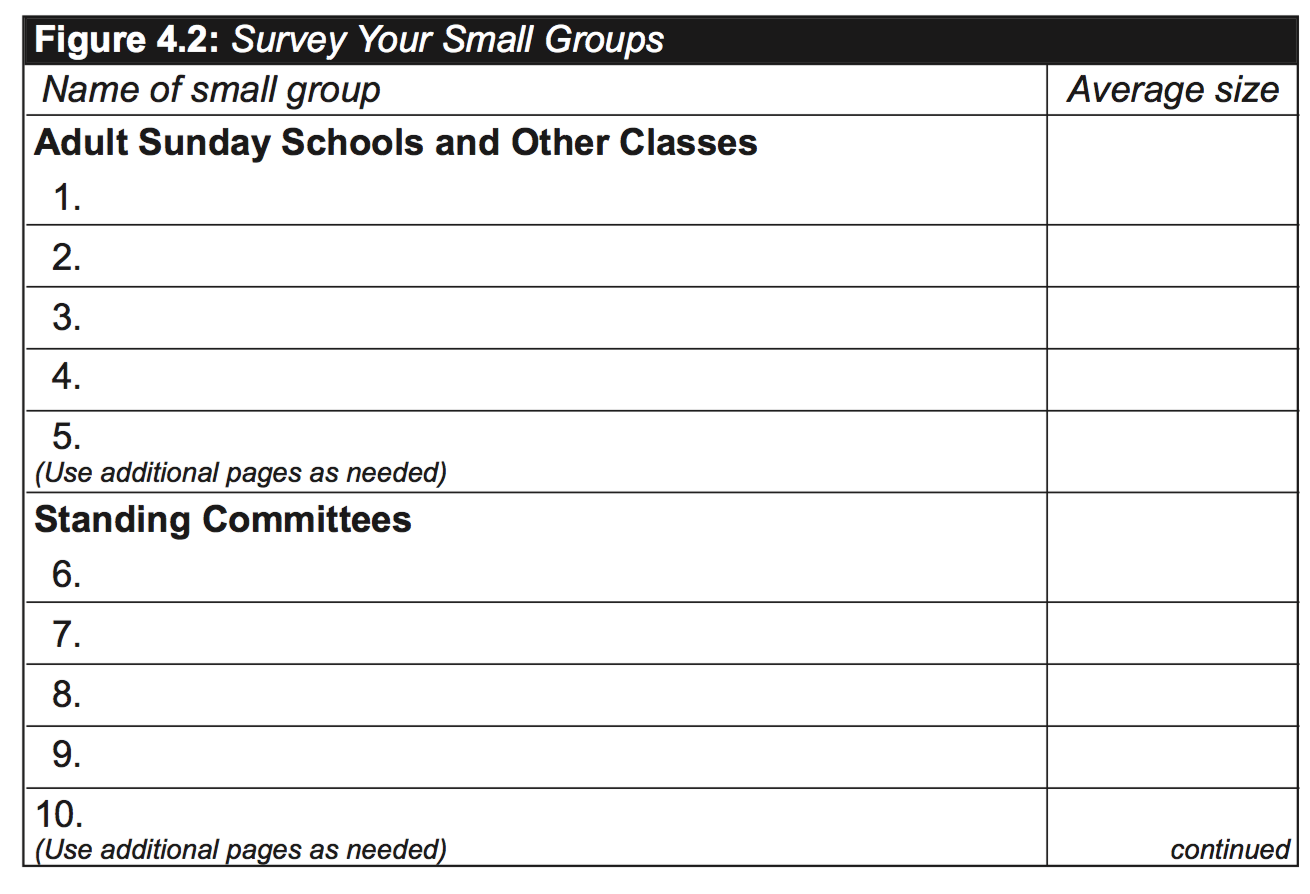 Now use your definition above with these charts (Figure 4.2) to count your small groups. Keep these guidelines in mind:
• Count only adult small groups at this time (teenage and above). While children need small groups such as Sunday schools, this chart will look at how to expand and refocus your adult groups.
• List your small groups under the type of group that best describes them. And, even though some groups could fit under several different types of small groups (for example, an adult Sunday school class could also be a task group), list each small group only under one type of small group. It is not as important that each group fits into the ideal category as that all groups are listed in Figure 4.2 (use additional rows as needed).
Are you surprised? Most churches are amazed by how many small groups they already have. But as 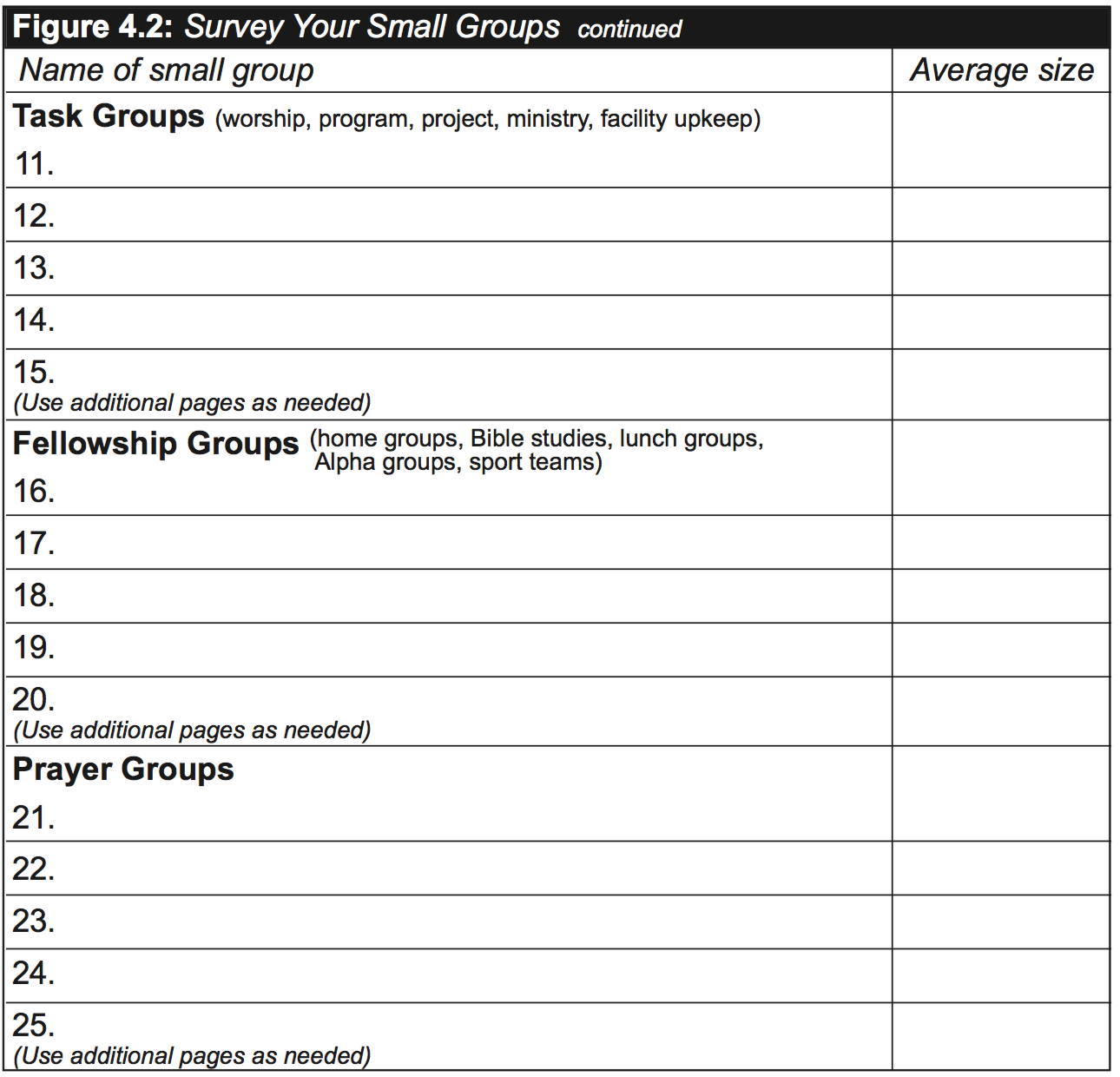 we noted in the story of Eastlake Church, this is why congregants often resist small group programs. When people are already attending an informal small group, such as a Bible study, Sunday school, committee, or sport team, they will often resist the idea of joining another small group.
Publicly recognize all of your small groups. After surveying your small groups, publicly acknowledge that all of these groups are small groups. People who already attend a small group will be less likely to balk at launching a small group program, because they understand their small group is already part of the program.
Once you know where your small groups are and how they are already teeming within your church, it’s time to move to the next part of the prescription: missionalize them.
Excerpted from Cure For The Common Church: God’s Plan to Restore Church Health, by Bob Whitesel (Wesleyan Publishing House 2012).
For further online notes: See Chapter 4 Complete Notes.