Book review: Clout (Discover and Unleash Your God-Given Influence)
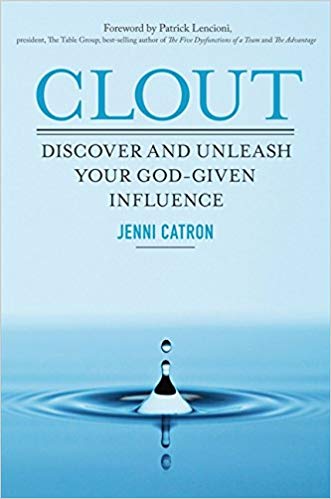 Clout: Discover and Unleash Your God-Given Influence, by Jenni Catron begins with a great endorsement in the Foreword by Patrick Lencioni who declares that it is one of the best books he has read (xv). That is impressive! I love Lencioni’s writing. Unfortunately, though I enjoyed this book, I don’t believe I would list it on my all-time favorite short list. Nonetheless, there are some helpful contributions here.
Catron focuses on clout and explains: “You have ‘it’ too. You were made to wield your God-given influence in such a way that makes others say, ‘she was made for that!’ (xviii). She adds: “Something inside each of us longs to count. We want to matter in the world” (xviii). Catron defines clout as: “Clout is the influence that God has given to you and to no one else. You are specifically designed to impact the world in a way that no one else can. Discovering your clout is an essential part of unleashing your purpose” (xix). She further explains: “Your God-given influence defines your purpose. Your purpose establishes your leadership. Your leadership makes a mark on the world” (xix).
Although I like much of what Catron says here, there is something inside me that pushes back a bit on this. Certainly, each person is unique, and therefore they will have to discover the leadership style that authentically matches who they are. However, I am not sure that the power of our clout comes from our uniqueness. Much of leadership is basic and relatively common to leaders.
Often it is not being a unique leader that impacts people, but practicing good leadership techniques. In the Bible, there are certainly plenty of interesting characters, but often you discover that they are pretty ordinary people. It was not their uniqueness that gave them influence over others, but their God. It was the active working of the Holy Spirit within them that gave them power and influence over others.
Catron identifies seven “clout killers” that stifle our clout. These are fear, comparison, jealousy, scarcity, insecurity, pride and control. Again, perhaps it is just the way the book is laid out, but I might have resonated better with it if she began by demonstrating what positive clout looked like in a healthy leader. Instead, the book immediately launches into seven ways that clout is quenched.
I appreciate Catron’s candor as she confesses her own shortcomings and insecurities. Clearly, she is a successful leader. Yet she suffers from insecurities that have harmed her leadership in the past. From the way the book is laid out, it might well have been titled, “The Insecure Leader” or “Overcoming Insecurity in Leadership.” I must confess that insecure leaders have been one group of people I have struggled to know how to help. Catron identifies ways that insecurities from fear or jealousy or pride can hinder leaders in their effectiveness.
Catron obviously has learned valuable lessons that have enriched her life and leadership. However, for those who have not had these experiences, you may find less in this book that is directly helpful to you.
Since at some point in our lives, most of us have dealt with fear, comparison, jealously, scarcity, insecurity, pride and control, then most of us should find something in this book that applies to us. Hopefully, you can read this book with the same honesty and candor as Catron used to write it.