
Book review: Trust Factor
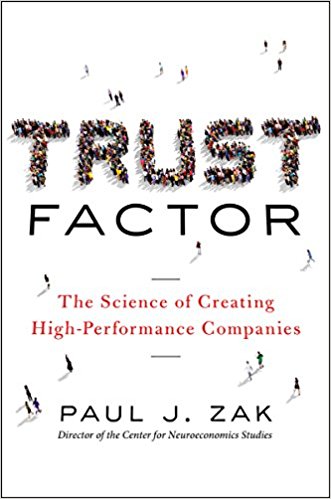 How important is trust for your church or organization? In Trust Factor: The Science of Creating High-Performance Companies, Paul Zak makes the case from neuroscience research that high-trust cultures lead to better organizational results. He explains that “employees in high-trust organizations are substantially more productive, have more energy at work … are significantly more innovative … effectively collaborate with coworkers, suffer less chronic stress, and are healthier and happier than employees working at low-trust companies.”
Zak’s research focuses on oxytocin, which is a chemical that is released in the brain in certain circumstances. His key finding is that oxytocin is produced “when we are trusted” and that this also “causes us to reciprocate trust by being trustworthy.” Zak has done a variety of workplace experiments and surveys that show the correlation between high trust and high performance (individually and organizationally).
The book is an interesting combination of neuroscience and examples from businesses. It doesn’t just advocate for the importance of trust, but also paints a picture of how organizations can move toward greater trust. Along the way, Zak addresses topics such as recognition, performance appraisals, teamwork, and chronic stress. I found many parallels between Zak’s work and other well-known leadership experts such as Patrick Lencioni, Daniel Pink, and Marcus Buckingham.
While Trust Factor has a number of helpful ideas, Zak’s organizing structure (using OXYTOCIN as an acronym) seems forced and creates some redundancies. His frequent references to his research and work with high-profile companies has a tone of unnecessary self-promotion. Perhaps most significantly, the agnostic approach in the research and the book leaves a void. It’s hard for me to think about the miraculous ways that our brains work, or to address topics such as trust and interpersonal relationships, except through the lens of a Christian worldview.
I’m convinced that trust is essential for an organization to reach its potential. But I’m equally convinced that trust flourishes best in soil that has been cultivated by and for God.